The Difference Between Countable Income and Excluded Income
Not every dollar you receive counts toward an eligibility threshold, and knowing which ones don't can change the outcome.
In one line
This explainer covers: Defining Countable Income
On this page
Defining Countable Income
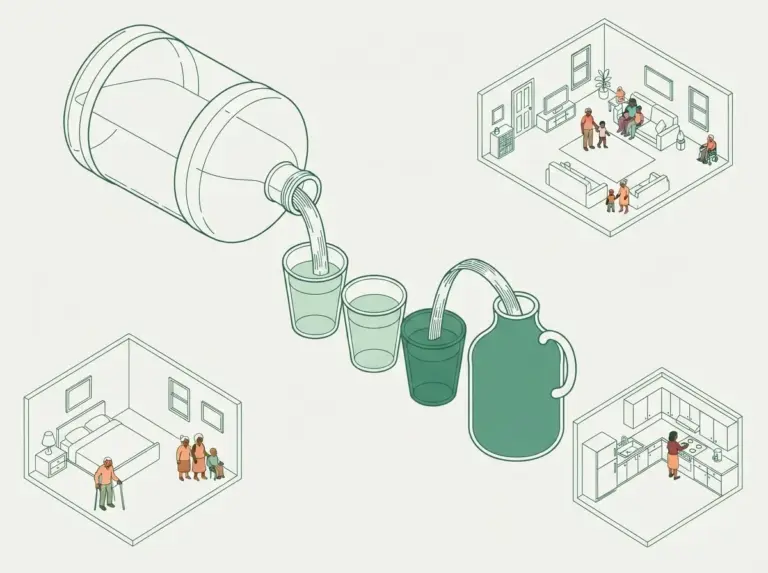
Every eligibility test that uses income as a factor starts with the same basic move: it takes the money coming into a household and sorts it into two piles. One pile counts toward the threshold. The other doesn’t. The number that actually gets compared to the program’s limit is not “how much money did you receive this year” — it’s “how much of that money does this particular program agree to count.”

This distinction trips up a lot of people doing their own back-of-envelope math before applying. They add up gross wages, a pension check, some child support, maybe a small gift from a relative, and conclude they’re over the limit. Sometimes they are. But sometimes several of those items don’t belong in the sum at all, and the honest total is lower than it looks.
“Countable income” is program-specific language, but the underlying logic is consistent: a benefit, subsidy, or discount program defines a category of income it cares about — usually something tied to the purpose of the program, like ongoing ability to pay for basic needs — and then explicitly carves out categories of money that don’t reflect that ability, or that the program has decided not to penalize for policy reasons. What’s left after the carve-outs is what gets measured against the threshold.
Common Categories of Excluded Income
The specific exclusion list differs by program, but certain categories show up again and again across public benefits, insurance subsidies, and discount programs. Knowing the general shape of these categories helps you know what to double-check, even though you’ll still need to confirm treatment against the specific program’s current rules before assuming anything applies to you.
- Certain need-based aid from other programs. Many programs exclude assistance you receive from other need-based programs, on the theory that counting one benefit as income for a second program would undercut the point of giving it in the first place.
- In-kind support. Non-cash help — someone letting you live rent-free, groceries from a food pantry, a utility paid by a relative — is frequently excluded or treated differently than cash, though some programs impute a value to it rather than ignoring it outright.
- One-time or irregular payments. A one-time gift, an insurance settlement, a tax refund, or a one-off inheritance is often excluded from ongoing income calculations, even though it might still be counted as a resource or asset under a separate test.
- A portion of earned income. Some programs don’t count all wage income dollar-for-dollar; they disregard a flat amount or a percentage before counting the rest, as an incentive to keep working.
- Specific categories tied to age, disability, or veteran status. Certain payments connected to disability compensation, veteran benefits, or age-related programs are excluded by some tests and counted by others — this is one of the more inconsistent areas, so it deserves specific verification rather than assumption.
- Reimbursements. Money that reimburses you for an expense you already paid — medical costs, work-related expenses, certain relocation costs — is often excluded because it isn’t really new income; it’s restoring money you spent.
- Income of certain household members. Some tests count only the income of the applicant and a spouse; others pull in every household member’s income; others exclude the income of a child or a non-applicant household member under specific conditions.
None of this is a checklist you can apply universally. It’s a map of the questions worth asking about your own income before you assume a program’s threshold rules you out.
Why Exclusions Exist
It’s worth understanding the reasoning behind exclusions, because it helps predict how a program is likely to treat income that isn’t explicitly listed anywhere you’ve checked.
Exclusions generally serve one of a few purposes. Some exist to avoid double-penalizing people — if you’re already receiving help because you have limited resources, most programs don’t want a second test to punish you for receiving that help. Some exist to preserve work incentives, which is why earned income often gets more favorable treatment than unearned income; a program that counted every additional dollar of wages against a strict threshold would discourage people from working more hours or taking a raise. Some exist because the payment isn’t really “income” in the plain sense — a reimbursement or a one-time gift doesn’t reflect an ongoing capacity to pay for things, which is usually what these tests are actually trying to measure.
Other exclusions exist for reasons that are less about logic and more about legislative or regulatory history — a specific type of payment was excluded because of a particular piece of legislation, a court decision, or an agency rule adopted at a particular point in time, and it has simply stayed excluded since. This is one reason exclusion lists don’t always look internally consistent from the outside. They weren’t built from a single unified theory; they accumulated.
Understanding the “why” matters because it tells you where to expect gray areas. If you have an unusual income source — a stipend, a settlement, an irregular gift, a benefit from a program you haven’t heard of — the question worth asking is: does this look like ongoing capacity to pay for basic needs, or does it look like something else (a one-time event, a reimbursement, help from another need-based program)? That framing won’t give you a definitive answer, but it tells you which direction to research.
How Exclusions Vary by Program Type
The single biggest mistake in this area is assuming that because a type of income is excluded for one program, it’s excluded everywhere. It usually isn’t. Each program category has built its own income test, often independently, and the differences are real.
Public benefit programs aimed at food, cash, or housing assistance tend to have the most detailed and most restrictive exclusion lists, because they’re often testing against a very low threshold and need to be precise about what counts. These programs frequently distinguish earned from unearned income, apply specific dollar or percentage disregards, and treat one-time payments differently from recurring ones.
Health insurance subsidy programs often use a tax-based definition of income as their starting point, which means they inherit whatever categories the tax system already excludes or includes, plus a short list of program-specific additions. This is a meaningfully different starting framework than a benefits program that defines income from scratch, and it means a payment excluded for tax purposes may or may not be excluded for the subsidy calculation — the two systems overlap heavily but are not identical.
Discount programs — utility discounts, reduced fees, transit or service discounts — often use the simplest tests, sometimes just a household income figure with a shorter exclusion list, or sometimes borrowing another program’s determination wholesale (for example, treating enrollment in one benefit as automatic proof of eligibility for a discount, without redoing the income math at all).
Because of this variation, the most reliable approach is to treat every program’s income test as its own self-contained system rather than assuming consistency. If you’re weighing whether to apply to more than one type of program, don’t assume that being excluded from one is a shortcut to knowing your status with another, and don’t assume a payment counted against you in one context will count against you in another. The only way to know is to check the specific definition of income that program publishes, alongside its current threshold, and compare your actual income against that definition — piece by piece rather than as one lump total.