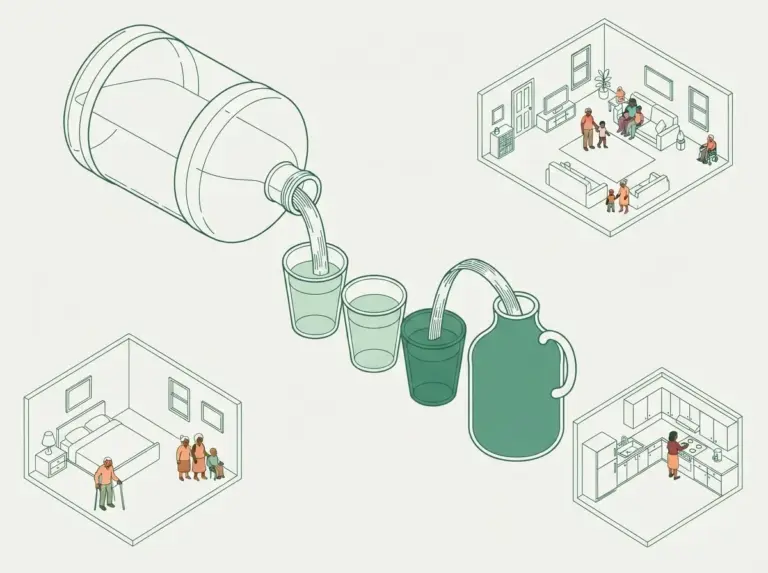
Fig. 1 Income & Asset Tests
Qualifyably looks at how eligibility decisions are made for public benefits, insurance subsidies and discount programs.
Sharing an address doesn't mean sharing a household under most program definitions.
The word 'household' means something different to a food assistance office than it does on a tax return.
An adult child under the same roof can shift household size, income counting, or both, depending on the program.
Some programs waive the usual income calculation once disability status is established through the right proof.
Age thresholds don't just add a discount — they can swap out the entire eligibility formula.
Veteran status can simplify an application, but it rarely waives every part of the underlying test.
Learn why some programs test what you earn before deductions while others test what's left after them.
Some asset tests exclude retirement savings entirely, while others count every dollar against the limit.
Not every dollar you receive counts toward an eligibility threshold, and knowing which ones don't can change the outcome.
Self-employment income is verified differently than a paycheck, and the standard of proof is usually higher.
A single pay stub often can't answer the questions a verification standard actually asks.
A physician's letter is often just the starting point for how disability status actually gets confirmed.
Crossing an income threshold by a small margin can change a subsidy far more than the margin itself.
A raise, a new job, or a lost contract can all set off a subsidy recalculation before the year is over.
Adding or losing a household member shifts the poverty-line comparison that drives the subsidy formula.
Most senior discounts run on age alone, but a few quietly add an income or need-based layer.
Proving you're a student for a discount program isn't the same as proving enrollment for financial aid.
Hardship-based discounts range from self-attestation to full documentation, and the difference isn't random.
A simplified picture. Real programs order and combine these tests differently.
Fig. 1 Income & Asset Tests

Fig. 2 Income & Asset Tests

Fig. 3 Income & Asset Tests

Fig. 4 Income & Asset Tests

Fig. 5 Categorical Triggers

Fig. 6 Categorical Triggers
Tick things off as you gather them.
Pick what has just happened and see the categories of help worth checking.
Newest: Why Roommates Aren’t Automatically Part of Your Household
Newest: How Disability Status Can Bypass an Income Test Entirely
Newest: Gross Income vs. Net Income: Which One Actually Gets Tested
Newest: What Counts as Proof of Income When You’re Self-Employed
Newest: Understanding the Subsidy Cliff: What Happens Right at the Threshold
Newest: Do Senior Discounts Have an Income Test, or Just an Age Test
All of this is general information about how eligibility rules tend to operate.
The site is useful if you want to understand the logic of an eligibility decision before it is made.
We send detailed breakdowns of how income limits work, what counts as a household, and what documentation programs actually require. You get the mechanics behind the decision, not marketing language or application steps.
We send updates when we publish new eligibility guides. Your email address will not be sold or shared with other organizations.