Why Roommates Aren’t Automatically Part of Your Household
Sharing an address doesn't mean sharing a household under most program definitions.
In one line
This explainer covers: How programs define a household
On this page
Move in with a roommate and the mail still comes to one address, but that doesn’t mean an eligibility worksheet treats the two of you as one unit. This is one of the more persistent points of confusion in benefit and subsidy applications: people assume “household” means “everyone who lives here,” when most programs actually build the term around something narrower — who is financially and legally tied to whom. Getting this wrong in either direction can change your numbers substantially, so it’s worth understanding the actual test before you fill anything out.
How programs define a household
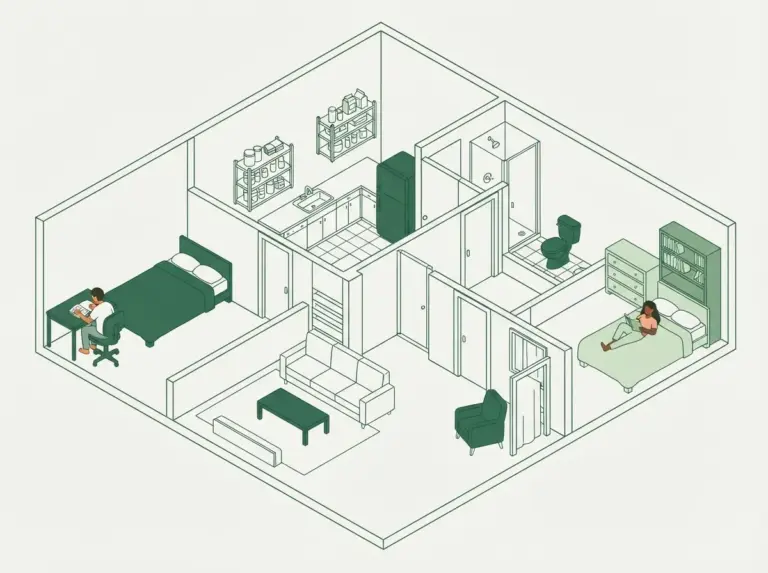
Almost no program defines a household as “the people who share a lease or a front door.” Instead, they tend to lean on one of two organizing ideas, sometimes blended together:
- Tax household logic. Programs tied to tax filing status — this includes most health insurance subsidy determinations — generally build the household around the tax filer, their spouse if filing jointly, and anyone they claim as a dependent. If you don’t claim your roommate as a dependent and they don’t claim you, you are, by definition, separate households for that program’s purposes, even if you split every bill evenly.
- Family and relationship logic. Programs rooted in older public-assistance frameworks — certain food, cash, or housing assistance programs — often define household around family relationships and, in some cases, whether people who aren’t related still function as a single economic unit (buying and preparing food together, for instance, in some food-assistance rules). This is where things get less clean, because “functions as an economic unit” is a judgment call the agency makes, not just a box you check.
Neither approach treats shared address as the deciding factor. Address is evidence used to figure out who might be connected, not the definition itself. Two adults can have the exact same apartment number on their ID and still be assessed as entirely separate applicants.
Shared address vs. shared finances
It helps to keep these two things mentally separate, because paperwork often conflates them:
- Shared address is a logistical fact. It tells an agency where to send mail and sometimes triggers a closer look, but it isn’t proof of anything about your finances.
- Shared finances is the thing most programs actually care about — whether income, expenses, or resources are pooled or treated as common property between people.
Roommates who split rent, split a utility bill, and otherwise keep separate bank accounts, separate grocery budgets, and separate tax returns are, in the eyes of most programs, financially separate people who happen to share square footage. The rent-splitting spreadsheet you keep with your roommate is not the same thing as a shared household budget in the eyes of an eligibility worker — even though from the outside, “we split everything” can sound identical to “we’re one household.”
This is why two roommates with identical incomes and identical rent can get different subsidy amounts, different premium tax credit estimates, or different benefit calculations depending on filing status, dependents, and whether either one supports the other financially in ways that go beyond splitting a bill. The address is a coincidence of geography; the finances are the actual variable being measured.
When roommates do count
The exceptions are narrower than people expect, but they matter:
- One roommate claims the other as a dependent. If you provide more than half of a roommate’s financial support and they otherwise qualify as your dependent under the applicable tax rules, that relationship can pull them into your household for programs that use tax-household logic — regardless of the fact that you’re not related.
- You’re married or in a legally recognized partnership, even if you call each other roommates informally. Some people describe a spouse as a “roommate” out of habit or privacy, but if you’re legally married, most programs will still treat you as one household for eligibility purposes. The legal relationship overrides the casual label.
- You share and prepare food together as an economic unit, under programs that use this test. Certain food-assistance frameworks ask not just who lives together but who buys groceries jointly and eats meals prepared together as a shared arrangement. Two roommates who cook separately and buy separate groceries typically fall outside this even under a food-focused household test; two roommates who function like a shared kitchen and shared grocery budget may not.
- One roommate has legal custody or guardianship connected to the other. Dependent children, wards, or others under a roommate’s legal responsibility can be pulled into that household definition even without a marriage or blood relationship.
Outside of these situations, simply signing the same lease, splitting a security deposit, or being listed together on a utility account does not typically merge two people into one household for eligibility math. The test is about legal and financial interdependence, not proximity.
Why the distinction affects your numbers
Household size and household income are usually the two inputs that drive an eligibility calculation, and they interact. A larger household with the same income often looks more favorable for programs with income limits, because the same dollar amount is being measured against a bigger household size — most programs scale their income thresholds upward as household size increases. Add a roommate to your household count without adding their income, and your numbers might look better than they should. Leave a roommate’s income out entirely because you correctly treated them as a separate household, and your own numbers reflect only what’s actually yours.
Get the household definition wrong and you risk two different problems. Overstating your household — folding in a roommate who shouldn’t be there — can inflate the household size used in an income-limit comparison without a matching increase in countable income, sometimes producing an eligibility result that doesn’t hold up under review. Understating it — leaving out a roommate who actually qualifies as a dependent or spouse — can produce a determination based on incomplete information, which can also unravel later if verified.
Neither mistake is really about dishonesty; it’s usually about applying an everyday, common-sense idea of “who I live with” to a technical term that means something narrower and more specific. Before listing anyone on an application as part of your household, it’s worth checking the specific program’s definition rather than assuming the address on your ID settles the question. Program handbooks and official eligibility guidance typically spell out the exact test — tax dependency, marriage, legal guardianship, or shared food economics — and that test, not the lease, is what actually decides who counts.