How Programs Define ‘Household’ Differently Than the IRS Does
The word 'household' means something different to a food assistance office than it does on a tax return.
In one line
This explainer covers: The IRS Tax Household Concept
On this page
The IRS Tax Household Concept
When the IRS defines who belongs together on a tax return, it is answering a narrow question: who can be claimed as a taxpayer, a spouse, or a dependent for the purposes of that specific filing? The core mechanism is the tax filing unit, not a household in the everyday sense of “people who live under one roof.”
A tax household, for the purposes that matter to benefit and subsidy programs, generally consists of:
- The person filing the return
- That person’s spouse, if filing jointly
- Anyone claimed as a dependent on that return
Dependency itself has its own test, involving relationship, residency, age, and support criteria that the IRS applies to determine whether someone can be claimed. A adult child who lives elsewhere but receives more than half their support from a parent might still count as part of that parent’s tax household. Conversely, a cousin who has lived in the same home for years but files independently and isn’t claimed as a dependent is not part of anyone else’s tax household, no matter how long they’ve shared an address.
This matters because several major programs — most notably subsidies for marketplace health insurance — borrow the tax household definition directly. If you want to know whether a program uses this concept, the giveaway is usually a reference to “modified adjusted gross income” or a requirement that you report your household based on who you expect to claim on your tax return for the relevant year. That’s a strong signal the program is using the IRS’s household logic, not its own.
The Benefits-Program Household Concept
Many public benefit programs, particularly those focused on food, cash, or housing assistance, use a completely different organizing idea: people who live together and share meals, shared this is sometimes described as sharing “housekeeping” or purchasing and preparing food together. The technical language varies by program, but the underlying question is functional and observational rather than tax-driven: who actually lives in this home, and to what degree do they function as one economic unit for food and daily expenses?
Under this model, household composition is typically assessed by looking at:
- Who resides at the address on a regular basis
- Whether residents purchase and prepare food together or separately
- Relationships between residents, since certain relationships (like spouses, or parents and minor children) are often presumed to be one household regardless of separate food arrangements
- Temporary versus permanent presence — a houseguest staying briefly is treated differently than someone who has moved in
This means a household, in the benefits sense, can include people who would never appear together on a tax return: two unmarried adults sharing an apartment and splitting grocery bills, a grandmother who lives with her adult grandchild and buys food separately, or a boyfriend and girlfriend with no legal or tax relationship at all. It can also exclude people who share a legal address but function as separate economic units, such as a homeowner who rents out a room to a tenant who buys and cooks their own food.
Programs that use this model are typically trying to measure something closer to actual shared economic life at a specific address, rather than the more formal, filing-based unit the IRS relies on.
Where the Definitions Diverge
The gap between these two models shows up in a handful of predictable, recurring scenarios:
Adult children living at home
An adult child who lives with a parent but files their own tax return and isn’t claimed as a dependent is outside the parent’s tax household. But that same adult child, under a food-purchasing household test, may well be counted as part of the same household if they share groceries and meals with the parent.
Unmarried partners
A couple who lives together but isn’t married is generally two separate tax households — each files independently, and neither can claim the other as a spouse. But under a residency-and-food-sharing test, an unmarried couple who shares an address and shares meals is frequently counted as a single household, and both incomes may be counted toward eligibility.
Separated spouses
Married couples who are separated but not yet divorced may still be treated as a single tax household in certain filing statuses, particularly if they haven’t legally finalized a divorce. A benefits program working from residency and shared-purchasing rules might treat them as two separate households the moment one spouse moves out and stops sharing meals, regardless of legal marital status.
Children of divorced or separated parents
Tax rules generally allow only one parent to claim a given child as a dependent in a given year, based on custody arrangements and IRS tie-breaker rules. A benefits program looking at physical residency might count that same child as part of both parents’ households in different months, or split the year differently than the tax rules would, depending on where the child is actually living and eating at the time of application.
Multigenerational homes
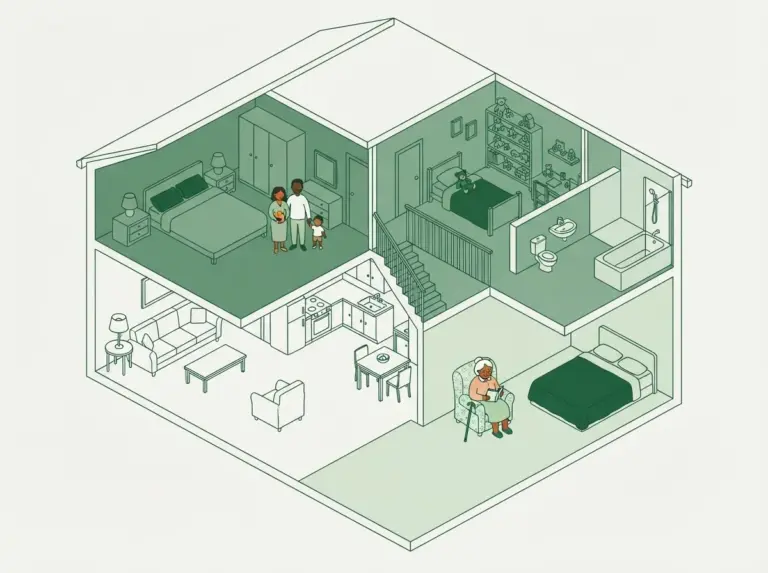
A household with grandparents, parents, and grandchildren all under one roof might be one enormous household by a residency-and-food test, yet represent two, three, or more entirely separate tax households depending on who files jointly, who is claimed as a dependent, and who files independently.
Why This Trips Up Applicants
The confusion is rarely about people misunderstanding their own living situation. It’s about assuming that a household determination made correctly for one purpose will transfer cleanly to another. Someone who has just gone through the tax filing season with a particular household composition in mind — spouse, two dependent children, done — may walk into an application for a different kind of assistance assuming that same list applies. If that program is actually asking who shares food and residency with them, the honest answer might include an adult sibling who lived with them for the last six months, or exclude a child who spends most nights at another parent’s home.
This produces two common failure modes. The first is under-reporting: an applicant lists only the people who would appear on a tax return, omitting someone who legally should be counted under the program’s own household test, which can lead to an eligibility determination based on incomplete information. The second is over-reporting: an applicant assumes a housemate or roommate must be included because they share an address, when in fact separate food purchasing or separate finances would exclude that person under the program’s actual test.
Neither mistake is unusual, and neither reflects carelessness so much as a reasonable but incorrect assumption that “household” is a single, portable concept. It isn’t. Each program defines it for its own administrative purpose, and that definition is written into the specific rules and worksheets for that program, not borrowed automatically from tax law or from any other program you may have dealt with previously.
The practical takeaway is to treat “household” as a term that needs to be looked up fresh for each program you’re evaluating, rather than assumed. Before estimating whether you’re likely to qualify for a given benefit or subsidy, find the specific definition that program uses — residency and shared purchasing, tax filing unit, or something else entirely — and apply it literally to your actual living situation, rather than reasoning from what worked out for you on your last tax return or a different assistance program’s rules. When in doubt about how a specific program defines the term, the program’s own eligibility materials or a caseworker for that specific program is the right place to check, since the definition is a matter of that program’s rules rather than a general legal question.